

Recently, at the invitation of the prestigious academic journal Nature, a team led by Academician Sun Xiaowei, Foreign Academician of the Russian Academy of Sciences, Executive Dean of the Institute of Nanoscience and Applications and Chair Professor of the Department of Electrical and Electronic Engineering at Southern University of Science and Technology (SUSTech), who is also a Senior Honorary Advisor of APSTA, published a research review article titled “Glasses-free display switches between 2D and 3D” in Nature News & Views. The article reviews the latest progress made by a joint team from Samsung Electronics and Pohang University of Science and Technology (POSTECH) in the field of switchable glasses-free 2D/3D displays.
近日,应顶尖学术期刊Nature邀请,俄罗斯科学院外籍院士、南方科技大学纳米科学与应用研究院执行院长、电子与电气工程系讲席教授(亚太科技协会高级荣誉顾问)孙小卫团队以“Glasses-free display switches between 2D and 3D”为题,在Nature News&Views专栏发表研究评述文章,对三星电子与浦项科技大学(POSTECH)联合团队在可切换裸眼2D/3D显示领域取得的最新进展进行评述。
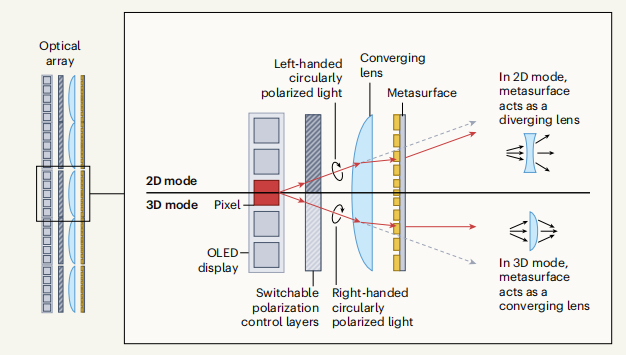
3D display technology creates a depth illusion by transmitting images with parallax from the same scene to each eye, thus achieving an immersive visual experience. However, most existing glasses-free 3D displays are based on traditional optical devices such as lenticular lenses, which have significant limitations. On the one hand, viewers can usually only obtain a good 3D viewing experience within a relatively narrow field of view; on the other hand, when the system switches to 2D display, the effective image resolution often decreases significantly, making it difficult to simultaneously meet the needs of wide-viewing-angle 3D displays and high-resolution 2D displays.
三维显示技术通过向双眼分别传递同一场景中具有视差的图像,产生深度错觉,从而实现沉浸式视觉体验。然而,现有裸眼3D显示大多基于柱状透镜等传统光学器件,存在明显局限。一方面,观看者通常只能在较窄视角范围内获得较好的3D观看体验;另一方面,当系统切换至2D显示时,有效图像分辨率往往会显著降低,难以同时满足宽视角3D显示与高分辨率2D显示的需求。
To address this long-standing technical challenge, a joint team from Samsung Electronics and Pohang University of Science and Technology (POSTECH) published a research paper in Nature entitled “Switchable 2D–3D display through a metasurface lenticular lens,” proposing a 2D/3D switchable light field display scheme based on a metasurface lenticular lens (MLL).
针对这一长期存在的技术矛盾,三星电子与浦项科技大学(POSTECH)联合团队在Nature发表题为“Switchable 2D–3D display through a metasurface lenticular lens”的研究论文,提出了一种基于超表面柱状透镜(Metasurface Lenticular Lens,MLL)的2D/3D可切换光场显示方案。
In a review article, Academician Sun Xiaowei’s team systematically explained the core optical principles, device structure, and fabrication methods of their work. The display system consists of a multi-layered optical structure including a cylindrical lens, an active linear polarizer, a polarization control film, and a metasurface lens. By electrically controlling the polarization state of the incident light, the device can rapidly switch between a wide-viewing-angle 3D mode and a high-resolution 2D mode, with a switching time of approximately 10 milliseconds. The research team used electron beam lithography to fabricate the metasurface lens and assembled a prototype optical panel with a thickness of only about 1.2 millimeters. The metasurface lens has an effective area of 25 square centimeters, achieving multi-viewpoint 3D display within a 100-degree field of view, demonstrating the significant application potential of metasurface optics in compact display systems.
孙小卫院士团队在评述文章中系统阐释了该工作的核心光学原理、器件结构与制备方法。该显示系统由柱状透镜、有源线偏振片、偏振控制膜以及超表面透镜等多层光学结构组成。通过电控方式切换入射光偏振态,器件可在宽视角3D模式与高分辨率2D模式之间快速切换,切换时间约为10毫秒。研究团队采用电子束光刻技术制备了超表面透镜,并组装出厚度仅约1.2毫米的原型光学面板。其中,超表面透镜有效面积达到25平方厘米,在100度视场范围内实现了多视点3D显示,展示出超表面光学在紧凑型显示系统中的重要应用潜力。
To address issues such as decreased spatial resolution, chromatic aberration, and display crosstalk at wide viewing angles, the research team further developed a light path tracing algorithm to analyze the propagation path of light as it passes through the metasurface and refractive lens, considering wavelength and angle. This algorithm can compensate for color distortion caused by differences in the focus positions of different colors and correct spatial misalignment between the red, green, and blue channels, thereby improving the consistency between the image actually seen by the viewer and the target view.
针对大视角下空间分辨率下降、色差及显示串扰等问题,研究团队进一步开发了光路追踪算法,用于分析光在通过超表面和折射透镜时与波长、角度相关的传播路径。该算法能够补偿不同颜色聚焦位置差异所导致的色差畸变,并校正红、绿、蓝三色通道之间的空间错位,从而提升观看者实际看到的图像与目标视图之间的一致性。
For more details, refer to the original link: https://newshub.sustech.edu.cn/html/202604/47528.html





Leave a Reply